
Why Concrete Is the Right Call for Tweed Heads Driveways
Asphalt softens in the heat. Pavers shift, stain, and let weeds through the joints. In a climate like Tweed Heads — where summer ground temperatures can push well past 40°C, where heavy rain dumps in short, intense bursts, and where salt air accelerates surface deterioration on almost everything — the material you put down matters enormously.
Concrete holds its shape. It doesn’t soften under a hot car tyre, it doesn’t heave after a big rain event, and it doesn’t need re-sanding every couple of years to stay level. For a coastal subtropical property, that’s not a small thing. It means a driveway that’s carrying vehicles properly ten years from now without you spending money on maintenance you didn’t budget for.
The load-bearing performance is the other part of the equation that homeowners don’t always think about upfront. A standard residential driveway sees a lot more weight than just the family car — delivery trucks, skip bins, caravans, trailers. Correctly reinforced and poured to the right thickness, a concrete driveway handles all of that without protest. Get the mix specification and reinforcement wrong, and you’ll see it in the surface within a few years.
That’s the difference between a driveway that’s built for this region and one that just happens to be in it.

How We Build a Concrete Driveway That Lasts
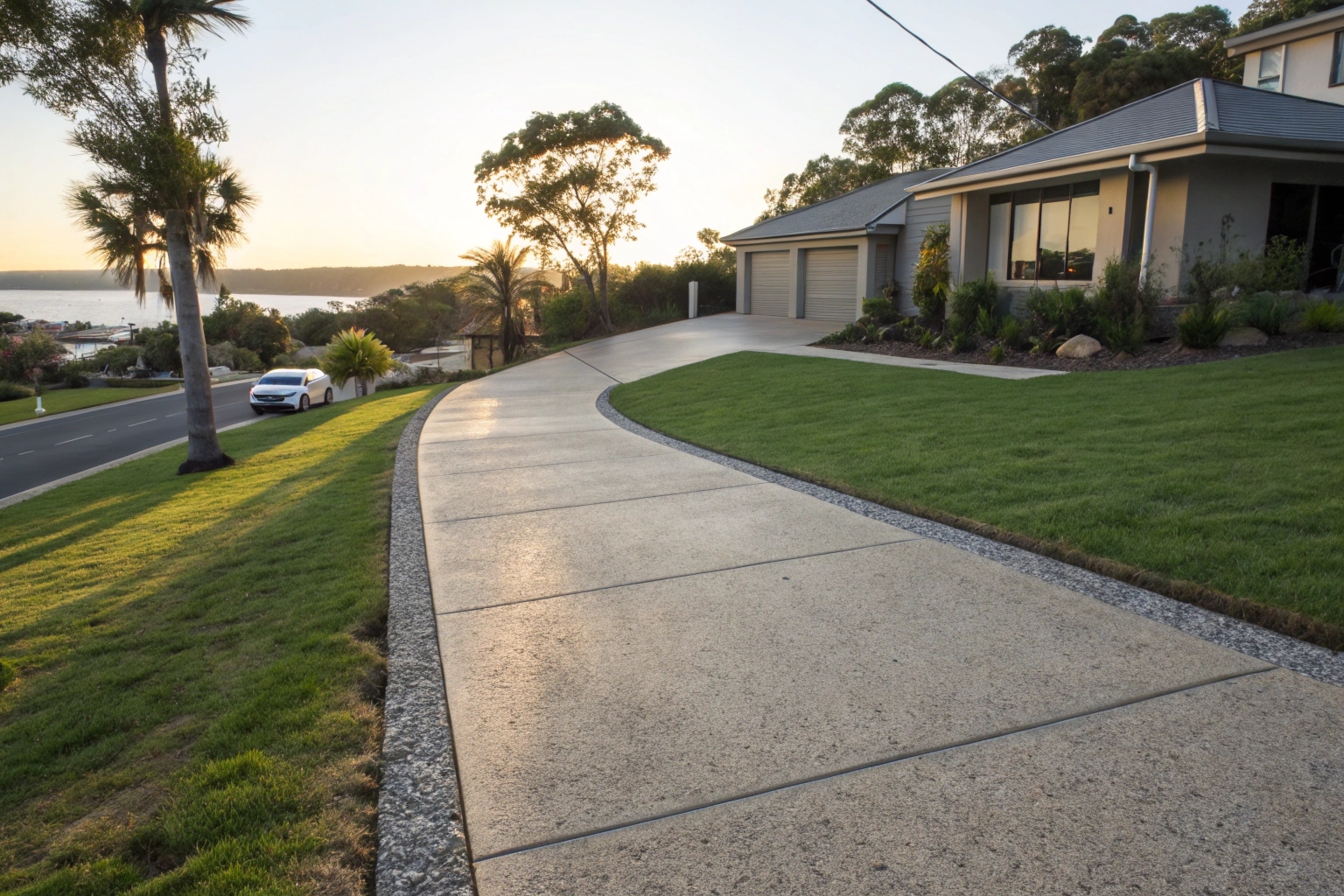
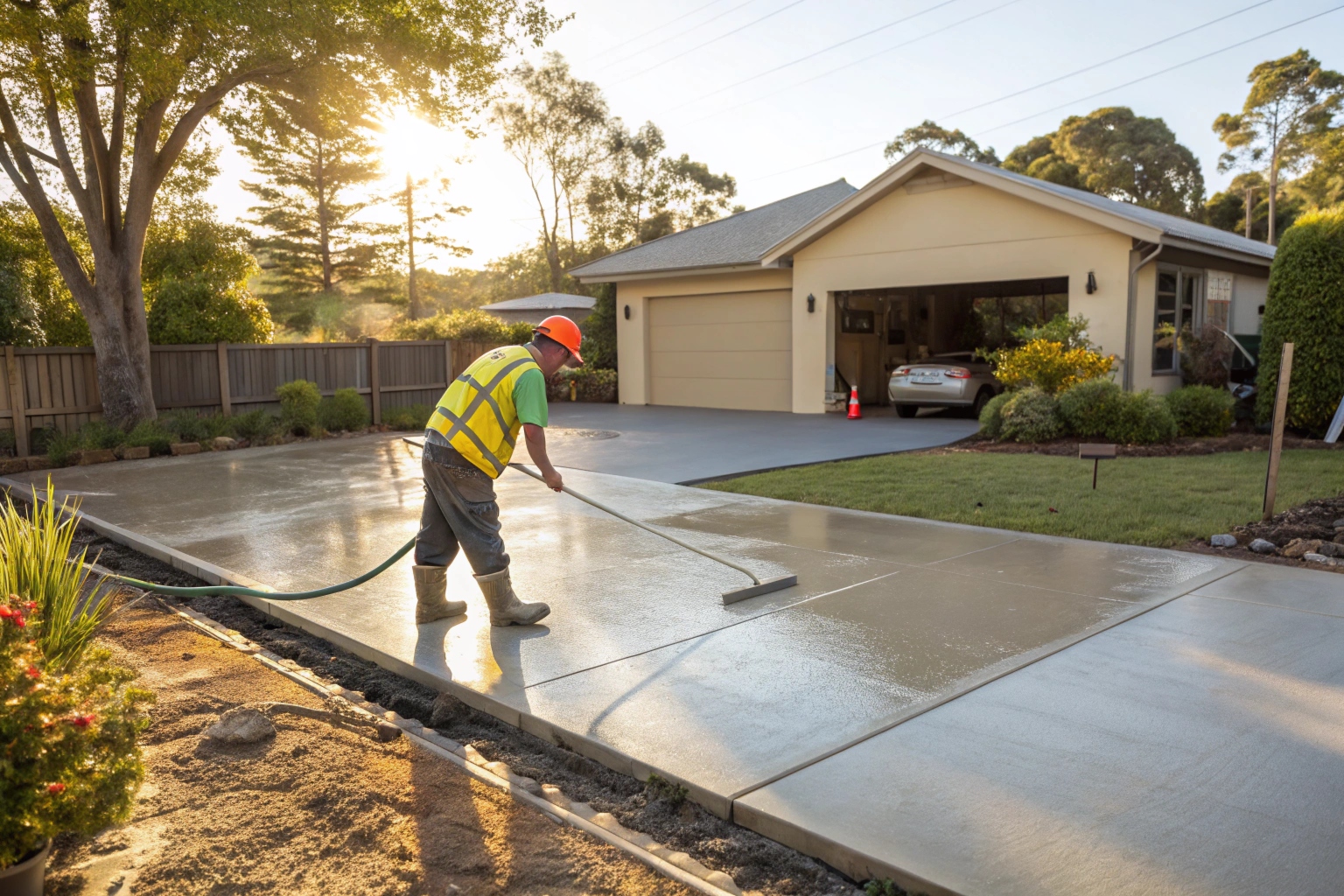
Every driveway we pour starts well below the surface. Proper subbase preparation is what separates a driveway that holds up from one that cracks within a few seasons — and it’s the step that less thorough operators are most likely to rush. We excavate to the correct depth, compact the subbase to a stable, even platform, and set formwork with edge detailing that gives the finished slab clean, defined lines. Reinforcement is selected based on your specific site and vehicle loading — mesh or rebar, specified for the job rather than defaulted to whatever’s cheapest. The concrete mix itself is chosen for coastal conditions, with the right water-cement ratio and admixture profile to resist the moisture cycling and UV exposure that Tweed Heads driveways deal with year-round.
Once the structural work is right, the surface is where the driveway becomes yours. A plain broom finish is practical, non-slip, and suits a lot of properties — but it’s far from your only option. Exposed aggregate opens up a lot of visual ground, particularly on properties where the driveway is a prominent feature from the street. Coloured concrete can be matched to your home’s exterior palette, and stamped patterns add texture and depth for homeowners who want something closer to a paved aesthetic without the maintenance headache. None of these are add-ons — they’re decisions we walk you through at quote stage so the finished product matches what you had in mind, not just what was easiest to pour.
The Details That Separate a Good Driveway From a Great One
There are a few things that come up on almost every driveway job in the Tweed region that homeowners don’t always know to ask about upfront — but that matter a lot to the finished result.
Council crossover compliance is one of them. Any new driveway connection to the street in Tweed Shire needs to meet Tweed Shire Council requirements for the crossover — the section between your property boundary and the road. Get that wrong and you’re looking at rectification work before the job is signed off. We handle the technical requirements as part of the project, not as an afterthought.
Drainage is the other big one. Tweed Heads gets serious rainfall in summer — fast, heavy, and often on ground that’s already saturated. A driveway that’s graded incorrectly sheets water onto neighbouring properties, footpaths, or back toward the house. We set falls and drainage outcomes as a deliberate part of the design, not something figured out on the day.
Expansion joint placement is the detail most homeowners only notice when it’s been done badly. Concrete expands and contracts through the heat cycles this climate produces. Without correctly spaced and cut control joints, that movement has nowhere to go except into a crack across the middle of your driveway. Placed properly, those joints manage the movement invisibly and keep the slab looking clean for years longer than it otherwise would.
These aren’t extras. They’re the standard we work to on every job.
Every Block Is Different — We’ve Seen Them All
Tweed Heads isn’t a flat, uniform suburb where every driveway job is the same pour on the same site. The region throws up a genuine variety of property configurations, and the approach changes depending on what you’re working with.
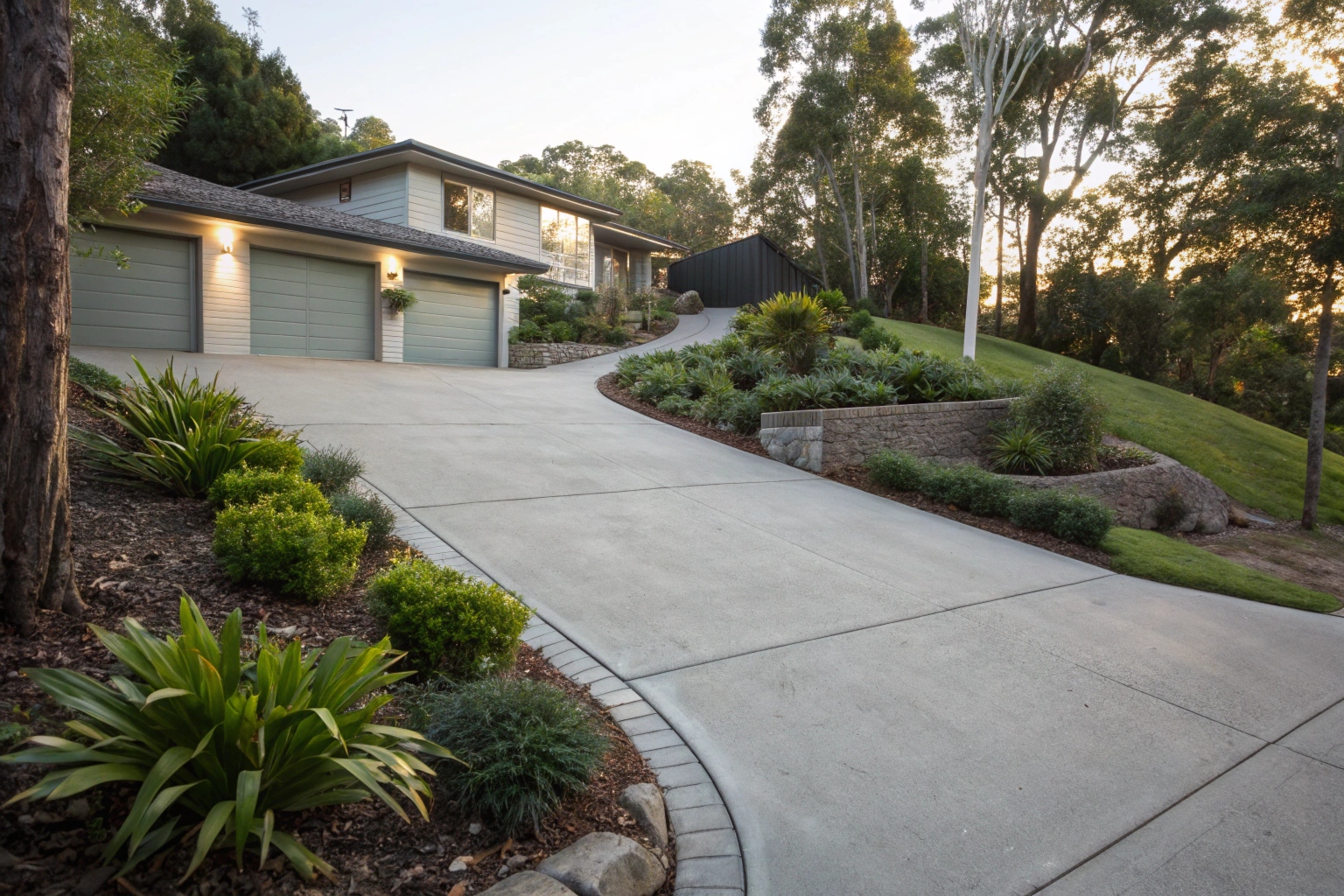
Older established streets in Tweed Heads and Tweed Heads South often have sloped blocks with significant grade changes between the street and the garage. That means getting the driveway fall right while still achieving a safe, trafficable gradient — too steep and you’ve got a wet-weather hazard, too flat and water pools at the base. Retaining edge details, side falls, and careful formwork placement all come into play on these jobs.
Banora Point and Terranora have their share of larger blocks with long driveway runs, sometimes with tight access on one or both sides. Concrete pump access, formwork sequencing, and pour timing all need to be thought through before the crew arrives on site.
In Kingscliff, Casuarina, and Chinderah, the newer estates are largely flat — but new build lots come with their own considerations. Subbase conditions on recently developed land can vary more than you’d expect, and getting compaction right matters on fill sites before anything gets poured.
Whatever the block, whatever the site, the process stays the same — assess it properly, plan the pour around what’s actually there, and don’t cut corners on preparation to save time. That’s how driveways get built that are still performing well a decade later.
Kerb Appeal That Actually Adds Value
A concrete driveway is one of the first things anyone sees when they pull up to your property — and in a market like Tweed Heads, where sea-change buyers are paying attention to presentation and lifestyle, that first impression carries real weight.
A well-finished driveway doesn’t just look good on the day it’s poured. It frames the front of the house, connects the street to the entry, and signals to anyone arriving — including future buyers — that the property has been looked after. That’s not a small thing if you’re planning to sell in the next few years, and it’s equally not a small thing if you’re staying put and want to actually enjoy coming home.
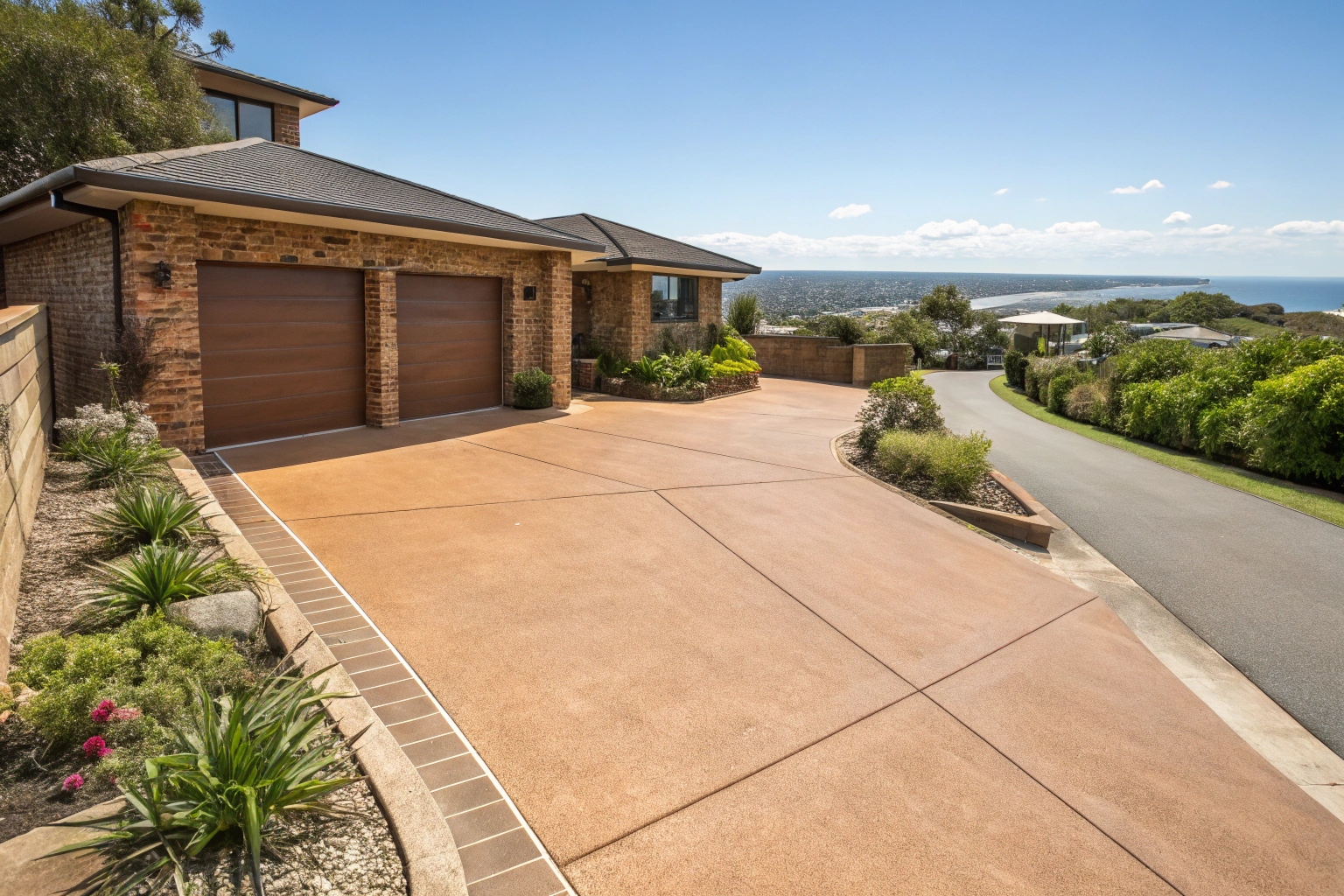
The finish you choose should work with the house, not against it. Exposed aggregate in a neutral tone suits a lot of the rendered brick and Colorbond homes common across Banora Point and Tweed Heads South. Coloured concrete in a warm grey or sandstone tone tends to complement the modern coastal aesthetic of newer Kingscliff and Casuarina builds. Stamped patterns work particularly well on wider driveways where the surface area is large enough for the texture to read properly from the street.
None of this needs to be complicated. At quote stage, we walk you through what works for your specific property — the façade, the landscaping, the wider streetscape — so the decision feels straightforward rather than overwhelming. The goal is a driveway that looks like it was always supposed to be there.
Licensed, Insured, and Straight With You From the Start
Hiring a concreter in the Tweed region shouldn’t feel like a gamble. But plenty of homeowners have been through the experience of a tradie who quotes low, takes a deposit, and either disappears or delivers something that looks nothing like what was discussed. It’s a real problem in this market, and it’s worth addressing directly.
We’re fully licensed and insured — not as a box-ticking exercise, but because it matters to the homeowners we work for. If something unexpected comes up on site, you’re covered. If the work doesn’t meet the standard we committed to, we fix it. That’s the baseline, and we don’t treat it as something worth negotiating around.
The quote process is free and straightforward. We come to the site, look at what’s actually there, and give you a written quote that covers the full scope — excavation, subbase, reinforcement, mix spec, finish, expansion joints, and crossover compliance where applicable. No vague estimates that blow out once the job starts. No surprises on the invoice.
We also don’t push you toward a finish or a scope that’s bigger than what you need. If a broom finish suits your property and your budget, that’s what we’ll recommend. If exposed aggregate is going to add real value to the streetscape, we’ll show you why. The conversation at quote stage is about your property, not our margins.
We service the full Tweed residential catchment — Tweed Heads, Banora Point, Tweed Heads South, Coolangatta, Chinderah, Kingscliff, and Casuarina. Get in touch for your free measure and quote.
Frequently Asked Questions — Concrete Driveways Tweed Heads
A properly installed concrete driveway in this region should perform well for 25–30 years with minimal maintenance. The key variables are subbase preparation, reinforcement, mix specification, and expansion joint placement. Driveways that fail early almost always have a problem in one of those four areas — not in the concrete itself.
If you’re replacing an existing driveway within the same footprint, approval requirements are generally minimal. If you’re creating a new crossover connection to the street, or widening an existing one, Tweed Shire Council requirements apply. We handle the technical crossover compliance as part of the project scope.
Generally 7 days for regular passenger vehicles, though we’ll confirm this based on the specific mix used on your job. Full curing strength is reached at 28 days, so heavy vehicles like trucks or skip bins should wait for that window where possible.
Exposed aggregate reveals the stone within the concrete mix by washing back the surface layer during finishing — it’s textural, non-slip, and suits a wide range of property styles. Coloured concrete uses a pigment added to the mix itself, giving a uniform tone across the surface. Both are durable — the choice comes down to the aesthetic you’re after.
Yes. Sloped blocks are common across older Tweed Heads and Tweed Heads South properties. We factor gradient, drainage falls, and safe vehicle access into every driveway design on a sloped site.
Get Your Free Concrete Driveway Quote in Tweed Heads
If your driveway is cracking, stained, or just not doing justice to the rest of your property, there’s no better time to sort it out. A new concrete driveway is one of the highest-return improvements you can make to a Tweed Heads home — it performs better, looks better, and holds up to this climate in a way that patched asphalt or shifting pavers simply won’t.
We work across the full Tweed residential catchment — Tweed Heads, Tweed Heads South, Banora Point, Coolangatta, Chinderah, Kingscliff, and Casuarina — handling everything from straightforward flat-lot pours on new build sites to more complex sloped and access-restricted jobs on established properties.
Every quote is free, on-site, and written — covering the full project scope so you know exactly what you’re getting before any work begins. We’ll walk you through finishing options at the same time, so you can see what works for your property and make a decision you’re confident in.
What you get when you call us:
• Free on-site measure and written quote
• Finish options explained and matched to your property
• Licensed and insured installation throughout
• Tweed Shire Council crossover compliance handled
• Experience across all block types and driveway configurations in the region
The process is straightforward and there’s no pressure to commit on the day. If the quote works for you, great — if you need time to think it over, that’s fine too.
Call us today or fill in the contact form to book your free concrete driveway quote in Tweed Heads.
